
What Are Mangroves Actually Worth? And Why We Keep Getting the Answer Wrong
8/11/20255 min read
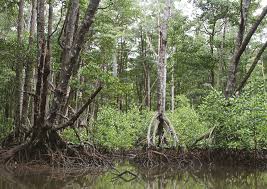
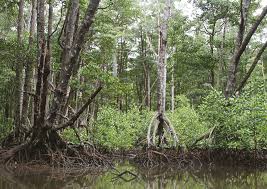
Mangroves don't look like much from a speedboat. Tangled, root-heavy, not exactly the postcard image of the coast or a beachfront holiday. But spend any time in them, kayaking, fishing, watching the light move through the canopy, and you understand immediately that you're inside something extraordinary.
You're also inside some of the most valuable real estate on earth. We just haven't learned to price it correctly yet.
Because despite everything they do, filtering water, nursing fish, locking away carbon, and standing between coastal communities and the full force of a storm surge, mangroves are still routinely cleared for resort beaches because they're in the way of the view, drained for marina developments because someone decided a tidal zone wasn't "productive," or quietly removed because no planning document required anyone to calculate what they were worth before they were gone.
That's the thing we consistently get wrong. We look at mangroves and see a problem. A space to clear, fill, dredge or drain. A checkbox in an environmental review. What almost never shows up in any approval process is the benefit they provide.
Let me try to put a number on it.
Per the Caribbean Diversity Fund, Caribbean mangroves are estimated to be worth between $23,000 and $45,000 per hectare just in storm protection value alone. Add fisheries nursery habitat, water quality for reefs and dive tourism, carbon storage, and erosion control, and the number climbs significantly. The Caribbean's fisheries and tourism industries, both of which depend directly on healthy coastal ecosystems, generate $5 billion and $47 billion in annual revenue respectively. Those industries don't exist without healthy mangroves, reefs, and seagrass beds. They are the foundation those industries are built on.
And yet, Caribbean mangroves have been reduced by almost 7,000 square kilometers in just three decades, from 1980 to 2010. At current rates, the science says they could be functionally gone within 60 years. We are dismantling the infrastructure that makes the Caribbean worth visiting, living in, and surviving.
The invisible infrastructure problem
When someone proposes coastal development; a resort, a marina, a residential complex, the planning process produces a very detailed picture of all the benefits that project will produce. Jobs during construction. Permanent hospitality positions. Tax revenue. Tourism spending multipliers. It's a compelling document, printed on glossy paper with beautiful images and ambitious numbers handed to municipal leaders who have no equivalent document showing what the site is currently providing.
That's the problem in a nutshell. We have sophisticated tools for estimating what development creates. We have almost nothing standardized for counting what nature provides before it's gone. So nature loses the argument by default, every time, even when the numbers tell a completely different story.
Per MarAlliance, Mangroves act as natural flood barriers, reducing storm impacts by up to 70%. Despite these benefits, mangroves continue to disappear in silence, few headlines, little investment, and a persistent misperception that they are "unproductive" spaces since they impede a direct view of the sea, inhibit construction and don’t contribute to the typical “beautiful coastal image”.
But we are missing a key point in the equation. We can't see what it's doing for us. Which is exactly the problem.
And let’s address the elephant in the room – the tension isn't simply "greedy developers versus helpless nature." It's far more complicated than that.
On a small island, tourism is often the only economic engine in town. There are no manufacturing sectors, no major technology industries, limited agricultural export markets. When a large foreign investment project arrives, even one that communities know will clear mangroves, degrade reefs, and permanently alter a coastline, it comes with the promise of jobs. Not always good jobs. Often construction jobs that last two years and hospitality jobs that pay minimum wage and disappear when the season ends. But any jobs, when your options are that limited, carry enormous weight.
We’ve all seen this dynamic play out many times. Communities that are genuinely opposed to a development, that understand perfectly well what it will do to the coast that feeds their fishing families and supports their livelihoods, still vote for it, or stay quiet about it, because they've been told it will bring work. And sometimes it does, for a while. And when the resort closes during the slow season, or the foreign investor walks away after a hurricane because the numbers no longer add up, the jobs are gone and the mangroves are gone too.
This isn't stupidity or short-sightedness. It's a rational response to a genuine absence of alternatives combined with a complete lack of information about the trade-off being made. Nobody told those communities that the mangroves they just cleared were providing $40,000 per hectare in storm protection that they now have to pay for some other way. Nobody showed them a number for the fishery nursery habitat they just lost, or the reef tourism value that would decline over the next decade as the water quality degraded.
The information vacuum is where bad decisions happen. Not because people don't care about their environment, most coastal communities in the Caribbean care deeply, but because the economic case for nature has never been made as clearly as the economic case for development.
And this destruction doesn’t just happen to small island developing states. In Florida, mangroves are legally protected under state law. You can't remove them without a permit. But permits get granted. Siesta Key, one of the most visited beaches in the United States and a significant driver of Sarasota County's $4 billion annual tourism economy, is surrounded by mangrove-fringed bays whose health directly supports the water clarity that makes those beaches worth visiting. Development pressure on those shorelines is relentless, and the planning process that reviews those development applications has no standardized way to document what the mangroves on a given site are worth before they're gone.
In Puerto Rico after Hurricane Maria, with 90% of the island's structures destroyed and the economic case for coastal resilience as stark as it could possibly be, coastal development approvals continued on the same basic terms as before. The urgency of reconstruction created pressure to streamline environmental reviews, exactly the wrong direction.
According to Conservation International, only 38% of mangroves and 11% of coral reefs located along the most vulnerable coastlines are currently protected globally. One-third of the coastal ecosystems without environmental protections have already been lost since 1980 due to development, aquaculture, and overfishing.
Here's what I've come to believe after years of watching this play out: the problem isn't that people don't value nature. It's that nature's value is invisible in the room where decisions get made.
If a coastal community anywhere in the world could see, in plain language, in dollar terms, on a public dashboard, that the mangrove fringe on a proposed development site is currently providing $2.8 million in annual storm surge protection for the adjacent neighborhood, employing the equivalent of $340,000 in annual fisheries value for local fishing families, and contributing measurably to the water quality that their tourism economy depends on... the conversation changes.
Because legislation exists across the Caribbean. Trinidad and Tobago has a Coastal Zone Management Policy Framework. Jamaica has environmental impact assessment requirements. Dominica passed a Climate Resilience Act after Hurricane Maria. The frameworks are there. What's almost never there is a mechanism to make those frameworks visible in real time, at the moment a decision is being made, in a form that both the planning department and the public can actually engage with.
That's the accountability gap. Not just government accountability to law, though that matters enormously. Public accountability, the kind where a community can see for themselves what's being traded away, even when the government won't tell them.
Because here's what I believe and have seen: when people have information, they use it. When fishermen in Montecristi in the Dominican Republic understood that the mangrove recanalization project would bring fish back to their waters, they supported it. When tourism operators in Belize understood that reef valuation was embedded in permit conditions, they became advocates for it. The knowledge problem and the accountability problem are the same problem.
We don't have a shortage of people who care about their coasts. We have a shortage of tools that make the value of those coasts visible before they're gone.